
Vintage Violence: Doing it for the Views
By Rohan Connolly
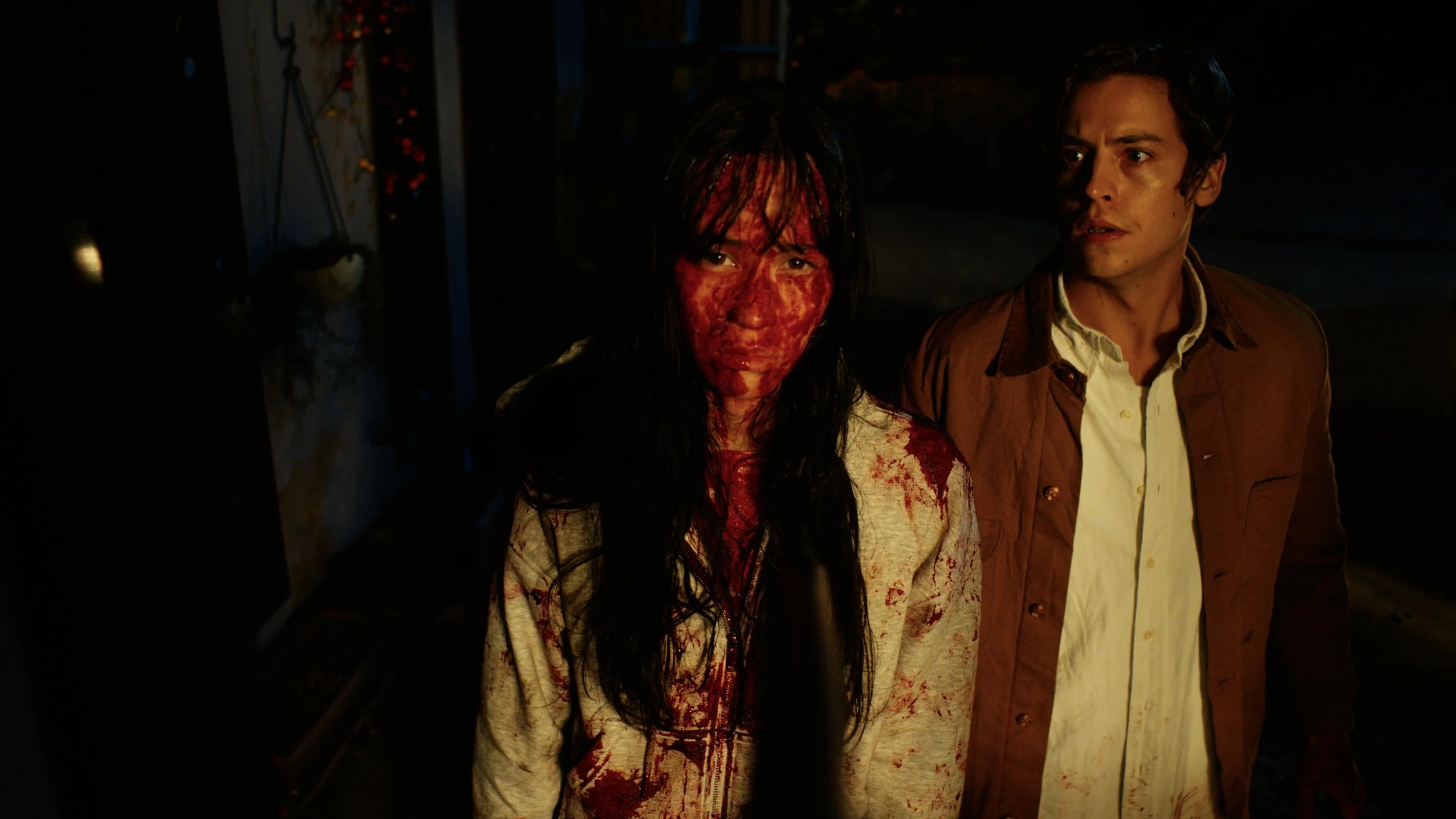
Eugene Kotlyarenko’s latest social media-centric, action thriller Vintage Violence is a hit. The film celebrated its world premiere during the Midnight Madness program of the Toronto International Animation Festival and cemented Kotlyarenko as one of the few directors who can successfully translate online culture to the big screen.
The film follows Carter (Cole Sprouse), an urban exploring livestreamer who is riddled with controversy regarding the death of his co-host Alex, after he stumbles across a hidden cache of ultra-rare vintage Levi’s. Izumi (Kiko Mizuhara) is one of his followers and convinces him to travel to Tokyo with the intention of making a fortune selling the jeans in Japan’s vintage market. Over the course of their adventure, the two become entangled with each other, with Izumi’s boyfriend Hiro (Nijiro Murakami) as he hopes to steal the jeans to pay off his own debt, with Ko (Pierre Taki) a disgraced Yakuza member seeking revenge on those who exiled him, and Edoga (Hio Miyazawa) a denim-clad, Levi’s obsessed crime boss. Characters double, triple, and quadruple-cross each other, with loyalties changing as quickly as fashion trends. The film ultimately is a jam-packed adventure across Japan, filled with chaos and full of fresh energy.
Vintage Violence is Kotlyarenko’s second film that uses the format of livestreaming to present its protagonist’s adventures, and fourth film that fuses the real with the virtual. Seemingly fascinated with the intersection of performance and reality, Vintage Violence is one of the few entries in recent years that feels truly entrenched in online culture. Many mainstream films today attempt to accurately portray the way that the virtual has manifested in our reality, but fail to actually do so. Usually, stories that take on this challenge end up feeling like elementary school PSAs about online safety or a lecture from out of touch parents, however, Kotlyarenko approaches the subject not with an intention of warning, but an understanding that the online world is part of our reality just as anything else. Every detail, down to the individual users in Carter’s livestream chat, feel deeply human and all too real, not as if these comments were written by professional writers but by the users themselves. It also utilizes this technology as a guiding force of the story, notably in a particularly inspired chase scene where Carter and Izumi are sharing a pair of Airpods. Carter, searching for Izumi, uses the music in his ear to lead him in the right direction; when the music starts to cut out, he knows he’s gone too far and runs in the opposite direction until the song plays without interruption.
Cole Sprouse delivers a standout performance of the annoyed, confused, and simultaneously disconnected from his emotions yet surprisingly vulnerable Carter, and Kiko Mizuhara is magnetic as the chic, ruthless, Izumi torn between her affection for Carter and her own desperation. The editing is quick, snappy, and enthralling as it mimics the ways in which social media preys on our shortening attention spans. The soundtrack is invigorating, matching the high energy of the film, and the cinematography delivers in every way, capturing every unique angle possible.
Vintage Violence is a breath of fresh air on the big screen. After years of filmmakers trying and failing to adapt life online onto the big screen (with a few exceptions), Kotlyarenko cements himself as someone who understands the digital landscape as another layer within the real world. The film is as dynamic and unique as the world it is portraying. Yes, it offers more than a good time in its discussion of the disconnect between audiences and creators, the loss of humanity that comes with seeing the world through the lens of content, and what drives desperate people to scam, betray, and hurt others, but at its core, Vintage Violence is simply fun. It is absurd, gory, exciting, and guarantees a rewarding cinematic experience.