
Memories of a Forest: Family Trees
By Nirica Srinivasan
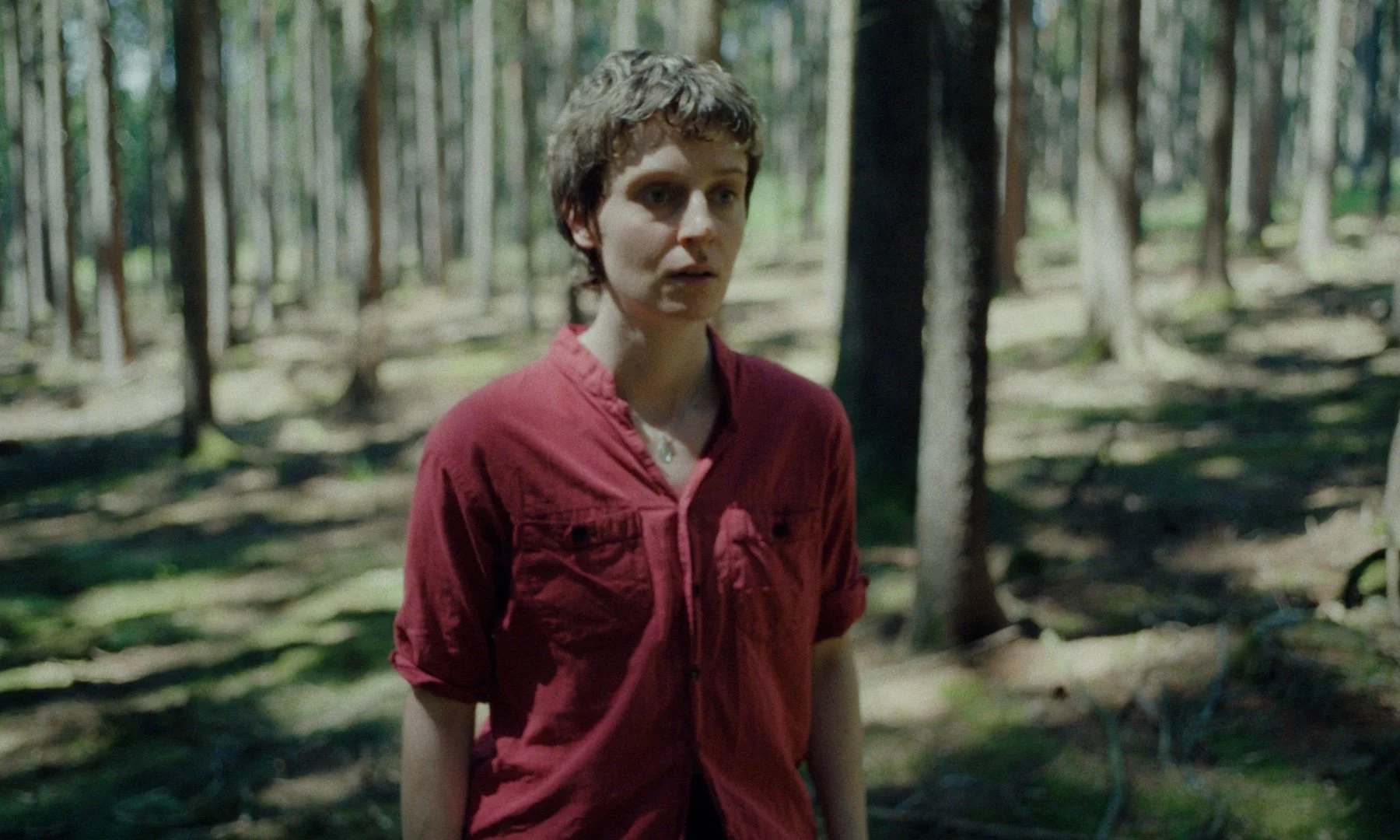
In Katharina Rabl’s debut feature Memories of a Forest (Erinnerungen eines Waldes, 2026), we meet Frieda (Julia Windischbauer), a final-year doctoral student working on her thesis at the University of Vienna. When she hears of her grandmother’s unexpected passing, she hurries home, where her parents are holding down the fort on their struggling family farm. There, Frieda learns something else unexpected: the will names her as the inheritor of a section of spruce forest, a place her grandmother held dear. On the train back home, Frieda thinks of her grandmother, who “was mostly alone, but never went away.” She adds, “And when I was born, life finally began.”
This strikingly individualistic statement signposts the journey Frieda is on. Literalized through the titular forest, Memories of a Forest is a story of roots and generations—the stories we know of the people who came before us, cycles of trauma and societal expectation, the precarious choice between tradition and forging your own path. Inspired by real experiences, and filmed with an almost documentary-like sensibility, using real forests and some non-actors, Katharina Rabl takes a relatively simple story and injects it with surprising complexity. But it feels, at times, just short of meeting its potential: hovering on the edge of something profound, but not quite getting there.
There’s much to admire in this film, particularly its gorgeous camerawork and strong performances. Dynamics play out in small and big interactions: We learn of Frieda’s strained relationship to her hometown and family by watching these subtle moments unfold. Her relationship with her mother (Johanna Orsini-Rosenberg) feels stilted and blunt. When Frieda’s train reaches the station, her mother waits in the car instead of on the platform; rather than offering her a hug, she reaches out to take the bag off Frieda’s shoulder. At the house, Friedrich (Lukas Walcher), a man she grew up with, doesn’t initially recognise her.
When Frieda inherits the forest, she’s more bemused than moved: “What am I going to do with a forest?” What can she do? She attempts to cut down trees herself, and sometimes with the help of Friedrich, to sell at the lumberyard. The scenes in the forest are few and far between given the name of the film, but they are some of my favourites—the quiet, calm and gentle breeze suddenly interrupted by a slowly falling tree. You can’t help but think of the famous philosophical question, “If a tree falls in a forest and no one is around to hear it, does it make a sound?” At times, Frieda is the only one there to hear it.
The parallels between the forest and Frieda’s family become apparent in small complications and complexities. The trees are infested with bark beetles; the family farm is failing. As Frieda spends more and more time at home and in the forest, the strained relationship between Frieda and her mother gains dimensions and hangs heavy over the family. Windischbauer, as our confused protagonist, puts on a fully believable performance of a woman estranged from home, procrastinating on her thesis, unsure of the future and trying to find a foothold in the present. But Orsini-Rosenberg’s layered performance balancing the grief of losing a mother and the difficulty of being one as well, is the standout of the film. Revelations about their family history quietly provoke Frieda and her mother to rethink their relationship to each other.
By the end of the film, Frieda makes her choice, looking toward the future with a nod toward the past, in a scene at the forest that ties the film’s themes together with admirable ease. In a meatier film, this scene might have felt stronger, more profound. But it seems like Memories of a Forest simply isn’t interested in creating that kind of payoff. Instead, it’s quieter, muddled, more ordinary, and more complicated—a lot more like reality.