
No Other Choice: A Veteran’s Playground
by Sydney Reyes
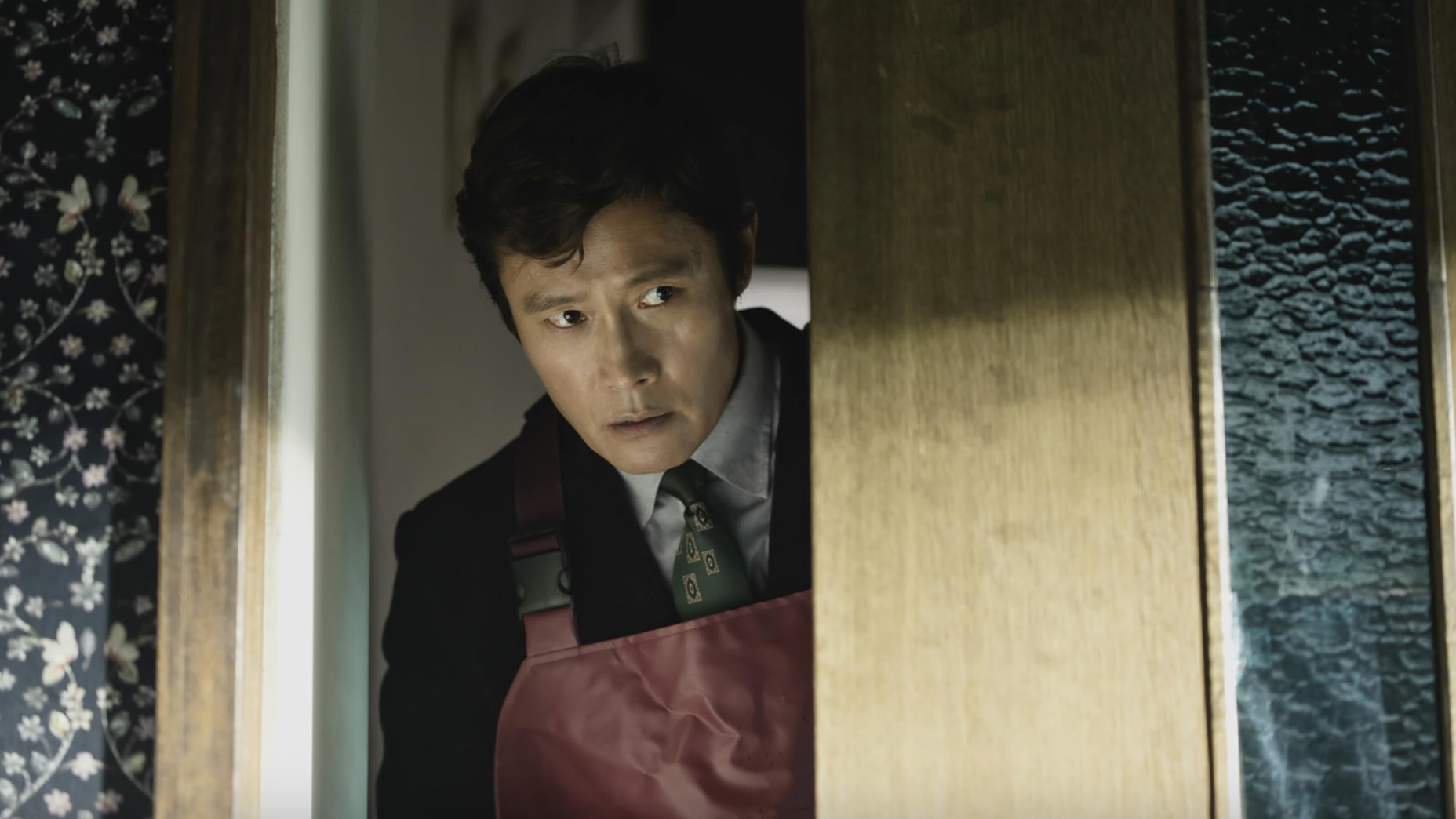
One of the wonders of cinema is the chance to explore the endless ways of dealing with something. Take, for example, the humiliation of losing a job and the grueling process of securing a new one. A film can showcase the process as something long and boring, another can go on a more inspirational route. Director Park Chan-Wook, along with the guidance of Donald E. Westlake’s 1997 novel The Ax, offers his filmic response to the ever-changing and challenging job market. No Other Choice (2025) follows Yoo Man-Su (Lee Byung-Hun), a manager at a paper company that gets laid off after working there for 25 years. Man-Su’s refusal to switch industries leaves him without a proper job to support his family for over a year, which is when he realizes that he must (literally) eliminate his competition to completely ensure that he’s the top candidate.
Park, one of South Korea’s most esteemed auteurs, is no stranger to making highly regarded films. His plethora of experience has helped establish his style and the flair that only he could add to a project. In this sense, No Other Choice might just be one of his most self-indulgent films. We’re hit with snappy pacing, with one event swiftly cutting to the next. This includes jokes and funny scenes sandwiched between cuts, giving the film more personality. Park is known for creative transitions and he uses them glaringly in No Other Choice. Almost every transition is a dissolve instead of the standard cut, providing a unique experience of breezing through the narrative and softly carrying the viewer to the next scene. It’s satisfying to witness Cinematographer Kim Woo-Hyung and Editors Kim Ho-Bin and Kim Sang-Beom tag team to deliver playful match cuts through pillowy transitions. From these visuals alone, the film is an extremely enjoyable experience. Add to that a crazy, unheard of narrative and Park’s ability to elicit big yet natural performances in his actors, and you have a classic and stellar film with the Park Chan-Wook label on it.
No Other Choice is a veteran’s playground. The film gathers the country’s most seasoned actors, from the two leads to the supporting cast. Lee Byung-Hun is known for his expansive work throughout the years in big projects such as Mr. Sunshine (2018), Squid Game (2021–2025), and I Saw the Devil (2010). Son Ye-Jin, Lee’s co-star who plays Yoo Mi-Ri is another household name most notably known for her role in the hit Korean drama, Crash Landing on You (2019–2020). The supporting cast include Yeom Hye-Ran, Lee Sung-Min, and Cha Seung-Won to name a few, all big names in the Korean screen industry. If you enjoy watching K-dramas, these five actors alongside the rest of the cast would not only have been a familiar face to spot, but also a delight to watch. No Other Choice is a plot that requires eccentricity, suspense, and a hint of melodrama that the actors organically delivered. They were shameless in bringing out the quirks of the story through their respective characters, resulting in this spectacle of a crazy film.
Lee Byung-Hun is usually the stern villain, the wise elder, or the handsome love interest in his roles. Park gifts the audience with a strikingly different performance in Lee. He brings out a side of the actor that has not been seen, and it was such a treat to watch. Man-Su is not ashamed of appearing pathetic—in one scene, he begs on his knees in front of executives to get a job, and in the next, he’s tripping and tumbling in front of the very person he’s attempting to kill. Man-Su pioneers a lot of the slapstick comedy in No Other Choice, masterfully propelling the plot forward at the same time. The physicality required in this film, perfectly fulfilled by Lee and the rest of the cast, in effect made for a laughter-filled cinema and a cheerful watch.
The use of phones in No Other Choice is another notable element that makes this film unique and successful. It felt more advantageous to the story than disruptive to the filmic reverie. Through the video calls and tablet screens, distinct technology jokes, and an up-close view of the actors’ facial expressions were better delivered. These were not just lazy props nor did they look fake and unrealistic like other films that heavily use phones. It was interesting to see how a seasoned director would incorporate this in their film, and No Other Choice did not disappoint.
In No Other Choice, Park knew that he could have fun with this ridiculous premise as his actors all have track records that are sure to serve. Every moving part is clearly woven with care and experience, leading to a well-crafted film. While there are a few loose ends to the plot, such as the reasons behind the weird behavior of Man-Su and Mi-Ri’s children, this doesn’t do much to deter the film’s greatness. No Other Choice is bold, comedic, and an exhibition of Park’s genius.