
Avatar: Fire and Ash: A Spectacle Meant for the Cinema
by Mars Dalys
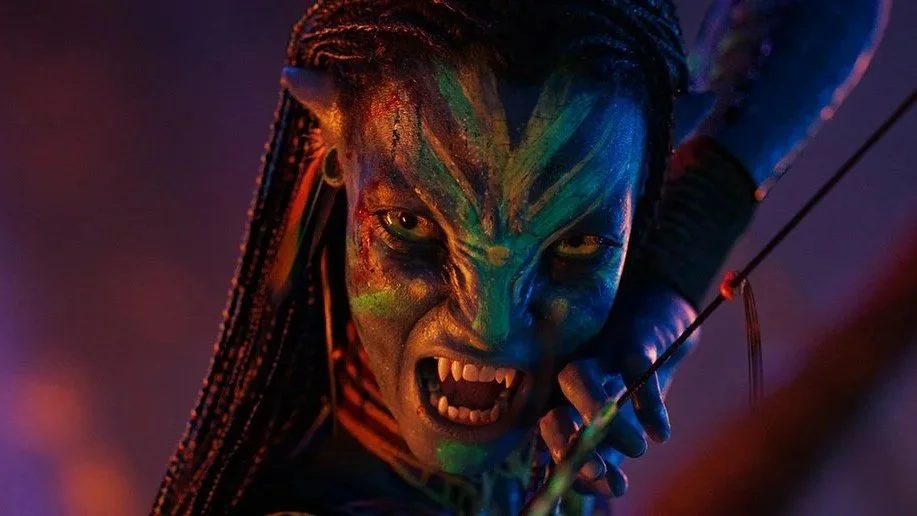
There are quite a few film franchises that managed to last for over 15 years, but maybe not as many that did it with only three films. With Avatar, that is exactly what James Cameron has achieved. Released in 2009, the first part is now widely considered a revolutionary work, bringing a whole new perspective on special effects to cinema and reshaping an entire generation’s way of seeing films. Sixteen years later and James Cameron just released the third movie in the series, Avatar: Fire and Ash.
Picking up right where its predecessor, Avatar: The Way of Water (2022), left off, the film digs into Jake (Sam Worthington) and Neytiri’s (Zoe Saldaña) lives with the Metkayina clan as they mourn the loss of Neteyam (Jamie Flatters). But there is another tribe that they soon meet: the Mangkwan clan. Led by the blazing Varang (Oona Chaplin) who believes that fire is the only religion, the clan ruthlessly torments Jake’s family—and they are not the only ones. Long-time enemy of Jake, Colonel Miles Quaritch (Stephen Lang) seeks revenge and is determined to get his son Spider (Jack Champion) back. As tensions escalate, stakes are also rising and soon enough, the lives of all of Pandora’s inhabitants are on the line.
Avatar: Fire and Ash has a lot of people to convince. Many of us have a deep attachment to the franchise, having discovered its first part in wide-eyed wonder in theaters or in between parents on the family couch. We grew up with Jake’s strength and Neytiri’s rage, with Eywa’s glow and Pandora’s beauty. So of course, when we are able to see them once again on the big screen, we cannot help but feel lucky. But we also cross our fingers for a sequel as good as the precedents. After seeing the film, most of us can agree on one thing: James Cameron’s directing skills have kept their grandeur.
Avatar is a franchise that brings cinema back to its origins. It is a spectacle. We sit in awe in our seats, captivated for over three hours by its technical prodigy. The visual effects supervised by Wētā Digital in New Zealand once changed modern 3D and they continue to take animation techniques to new heights today. In terms of special effects, the iconic striped blue skin and large eyes of the Na’vi are only the tip of the iceberg. We are also blown away by the numerous species living on Pandora: Ikrans, Toruk, Tsuraks, and Tulkuns. Each was created with care and ended up shockingly realistic. Pandora’s fauna and flora is a startling mirror of our own biodiversity which Avatar uses to encourage us to help our own planet in the Naa’vi way, with unity.
We can admit that scenario has never been what James Cameron is most acclaimed for, and we could criticize the plot lines of the film for heavily resembling its forerunner. However, he is such a master in the art of visual storytelling that we can forgive him. Messages pass in the stunning images, and Avatar: Fire and Ash is a film that you feel and see rather than intellectualize. Many frames would make perfect wallpapers and if we were not so invested in the action, we would pause the film to appreciate them.
Packed with the most epic battle scenes cinema has seen in a while and a talented cast taking us through an emotional roller coaster, Avatar: Fire and Ash is guaranteed to keep its audiences starry-eyed and on the edge of their seat.