There and Back Again: 25 Years of ‘The Lord of the Rings’
by Rohan Connolly and May Renault
As the lights in the theatre dim, the familiar face of Peter Jackson appears on the screen. He introduces the movie and reflects on the 25 years that have gone by since The Lord of the Rings: The Fellowship of the Ring was first unleashed to the world. He’s clearly filming this on his laptop webcam, his hair is unwashed and all over the place, and his words are obviously being spoken as he thinks of them; it feels like he’s on FaceTime with an old friend and, in a way, he is. Everyone in that theatre, seated for the grand finale of the trilogy, ready to finish the adventure, no matter if this viewing is their first or their 500th, is part of something special. Jackson remembers, thanks, and shares memories of those involved in the film who have passed: actors Ian Holm, Bernard Hill, and Christopher Lee, and Jackson’s close personal friend and creative partner Andrew Lesnie, a beloved director of photography who worked alongside Jackson for all of his projects. He reflects on his reluctance to return to narrative filmmaking since his friend's passing and his realization that all his projects following Lesnie’s death have only used archival footage because he can’t bear to find a new partner. Even before the film has started, I’m tearing up at these stories because at the heart of them are the powerful relationships forged on the set of Middle-Earth. And with that, Jackson tells us to enjoy, and signs off.
To be able to witness what are arguably some of the greatest cinematic feats of all time on the big screen is something I consider myself lucky to do. Even the act of watching them at home on my TV or even on a train on my laptop, feels like the greatest privilege. It’s not an understatement to say that we will never see something like these films ever again, and to witness them is pure magic. Other filmmakers, including Peter Jackson with The Hobbit trilogy, have tried to replicate that magic, but all have struggled to even come close. It was truly lightning in a bottle.
On December 19th, 2001, I was only a week old so I never had the opportunity to see The Fellowship of the Ring when it was released, as with the subsequent films The Two Towers (2002), and The Return of the King (2003). Despite this, the lasting legacy of these films has made it so that myself, those younger than me, and those who were around for the original releases can share in the joy of sitting in a theatre as Gandalf (Ian McKellan) shouts, “You shall not pass!” at a giant Balrog, as Boromir (Sean Bean) explains that “One does not simply walk into Mordor,” as Aragorn (Viggo Mortensen) announces that “The beacons of Gondor are lit!,” or as Samwise (Sean Astin) reminds us (and Frodo) that “there is good in this world” and that “it’s worth fighting for.”
But cinema is changing. The theatrical release is constantly being threatened by corporations who want us to be alone, and filmmakers struggle now more than ever to get projects greenlit. AI feels like it’s being forced down our throats, “second-screen” viewing is becoming increasingly popular, and actors are being cast based on follower counts. In a world where creative industries are being urged out of creation, Lord of the Rings is a healing experience. It is a nearly twelve-hour-long reminder that art matters, that it is essential to our very being.
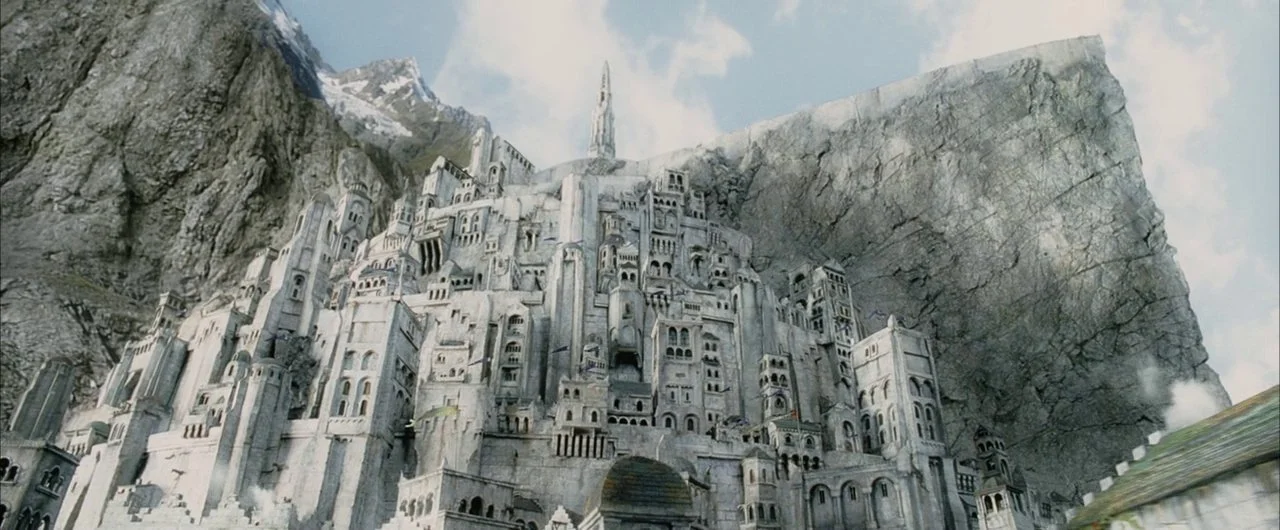
It is hard to think of today’s blockbuster movies as a love letter to the artistic medium, but The Lord of the Rings trilogy is. It pays homage to every possible creative field that exists within filmmaking. Thanks to the handiwork of the hundreds of workers from Wellington-based prop-making studio Wētā Workshop, and the partnership between founder Richard Taylor and Peter Jackson. If those movies have survived the test of time as well as they have, it is because it is all real: For years, blacksmiths forged swords like Anduril and dozens of replicas of the One Ring, and carpenters built real life-sized sets like Minas Tirith and Rivendell that actors could walk around. The unbelievable costume designing work of Ngila Dickson managed to create distinct visual identities for the many characters of Middle Earth, and all of it was carefully handmade; her very patient team individually sewed countless beads into the fabric, or joined together kilometers of chainmail in order to create realistic-looking combat gear. It is looking back on projects like this one, in which passion and human artistry were the fuel of creation, that reminds us why art is worth investing in.
If hope and love are the dominating narrative of The Lord of the Rings, fervor and dedication powered the production of such a cinematographic miracle. The technical aspect of filming was no easy feat. Three different camera crews shooting simultaneously on both of New Zealand’s islands to wrap on time shows that every detail was well thought of and cared for. On set, Sean Astin asked Director of Photography Andrew Lesnie why he put so much light in a scene that took place at night, and where the light would, realistically, be coming from. Lesnie took the moment to set off a spark of movie magic that perfectly encapsulated the philosophy of the fantastical on screen: “The same place the music is.”
On screen and behind the scenes, The Lord of the Rings is a story of perseverance. When Peter Jackson initially proposed his adaptation, all doors but one were shut in his face. He was told it was impossible, that no one would watch it, and that it wasn’t a film worth making. Yet in its 25th year, the films are still selling out theatres. In The Two Towers, Samwise says to Frodo (Elijah Wood), “How could the world go back to the way it was when so much bad had happened? But in the end, it’s only a passing thing, this shadow. Even darkness must pass. A new day will come. And when the sun shines it will shine out the clearer. Those were the stories that stayed with you. That meant something, even if you were too small to understand why.” Sam tells an entire theatre, who also may be too small to understand why, that the world that feels like it is crumbling around them, will not crumble forever. That the clouds will open up to show twinkling stars, that the sun will shine a crown on the king again. That there is always hope for tomorrow, whether that be taking down a dark lord, getting your dream film greenlit, or simply getting through the day. The Lord of the Rings reminds us of the possibility of storytelling, and of the good in a world bogged down by bad, so when the credits roll, and Annie Lennox sings you back into reality, you can walk back into the world a little more hopeful.