
By Nirica Srinivasan
In 2022, Georgia Oakley made her directorial debut with Blue Jean: a character study of a lesbian gym teacher in Thatcher-era England, determined to hide her personal life at all costs. When she sees one of her students at a gay bar, it triggers a crisis of sorts. It’s a tense film, often claustrophobic, but also so human and lived-in, anchored by a marvelous performance by Rosy McEwen as Jean. In one scene, Jean watches wild horses run across a field—an overused metaphor on paper, perhaps, but it becomes one of the film’s most moving moments, full of hope and the possibility of freedom.
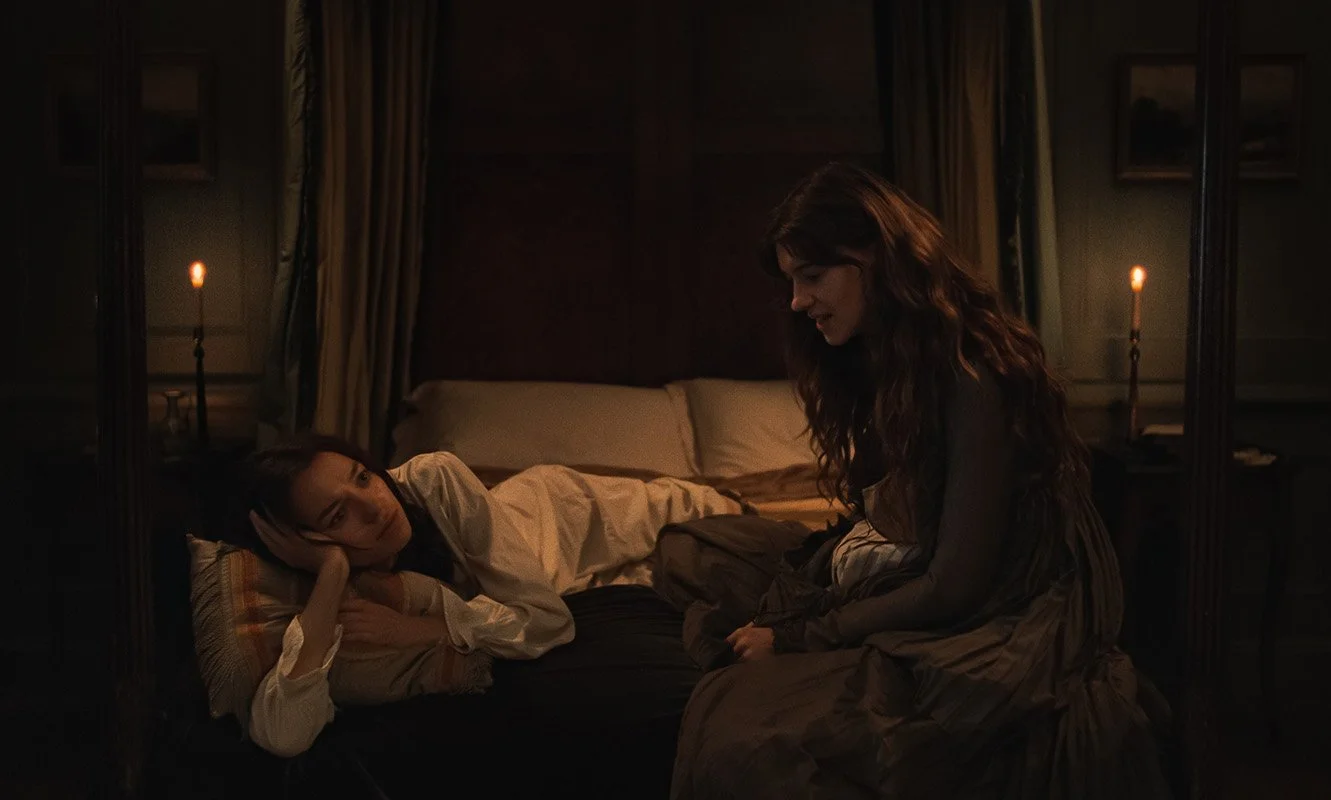
In many ways, similar themes recur across Georgia Oakley’s follow-up feature, Sense and Sensibility (2026). Here, too, the workings of society worm their way into private feelings and private lives. Adapted from Jane Austen’s debut novel, it is the story of two sisters, Elinor (Daisy Edgar-Jones) and Marianne (Esmé Creed-Miles), who exemplify the titular qualities of sense and sensibility. Rereading the book earlier this year, it struck me how melancholic Austen’s novel is—it’s a story of propriety and longing, of hopes raised and dashed to the ground, set against the backdrop of gloomy English weather. From the film’s opening frames, this mood is set: Oakley’s Sense and Sensibility, gorgeously shot in 35mm, is earthy and textured, a palette of deep browns, greens, and yellows.
There’s a lived-in quality to Sense and Sensibility, and much of its choices serve to emphasise this: the characters wear unpressed, muddy dresses, unkempt hair, and virtually no make-up. Details like these—heightened moments, heightened choices—make the film stand out from the period dramas we’re used to. A striking dance sequence at a ball, a staple of the period drama, is reimagined here with more modern choreography and evocative, exaggerated movements. In a dreamlike scene, Marianne finds herself in the woods alone with the threat of wild dogs running towards her; in that moment, she almost resembles Diana, goddess of the hunt. Viewers with better knowledge of either Austen or the time period might focus on inaccuracies in Oakley’s film, but it becomes clear that everything in this adaptation may be less concerned with verisimilitude and more concerned with creating an atmosphere, a mood, a feeling. The film’s tagline, after all, is “dare to feel.”
And surely, if there’s anything that anchors the film’s feelings, it’s the casting and performances, especially of its leads—Daisy Edgar-Jones as the quiet, thoughtful Elinor and George MacKay as the awkward, endearing Edward Ferrars. It’s no surprise that Edgar-Jones is spectacular as Elinor—Normal People (2020) put her on the map for playing a similarly lovelorn character—but she really shines here, bringing an openness and hopefulness to Elinor that keeps the performance youthful. There’s a cruelty in Sense and Sensibility that is all the more effective because of Elinor’s openness. She keeps her feelings close to her chest, governed by a sense of propriety. In Edgar-Jones’s performance, those feelings are palpable; and when they do burst to the surface, it looks like she’s surprising even herself.
MacKay is wonderful opposite her—if there’s anything to lament in Sense and Sensibility, it’s that there’s not very much of Edward, if only to see more of MacKay. The earliest scene in which Elinor and Edward meet features a moment of electric eye contact. In subsequent scenes, especially a pivotal one in an art gallery, they seem almost afraid to look each other in the eye again, for fear of being unable to hold their own feelings back. The central relationship of Sense and Sensibility, though, and one this film takes seriously, is between the sisters themselves. Esmé Creed-Miles plays Marianne in a state of heightened drama—she’s “sensibility,” after all. If Marianne is the storm across the moors, Elinor is a tempest contained in a teacup. As the film progresses, Marianne reins herself in, and Elinor learns to expand outward, each sister becoming a little more like the other.
It’s impossible to talk of Sense and Sensibility without bringing up Ang Lee’s 1995 adaptation, written by and starring Emma Thompson, but Oakley’s adaptation doesn’t feel intimidated by it—there’s a confidence in its aesthetics and direction that keep it singular. In fact, 2026’s Sense and Sensibility feels far more reminiscent of Far From the Madding Crowd (2015), another earthy, atmospheric film, or Greta Gerwig’s Little Women (2019), with its playful interpretation of the source material. There’s a timelessness to these films that keeps us coming back. Austen’s reality isn’t too different from our own, Oakley observes: courtship, marriage, societal expectations may have evolved, but realities of class, the foundation of patriarchy, and women’s place within them remain the same (an idea Celine Song tackled in 2025’s Materialists).
Oakley’s Sense and Sensibility takes care to paint a whole world, a mature interpretation of its source material that weds the escapism of the romance genre with a more grounded, sincere perspective. From Blue Jean to Sense and Sensibility, her films emphasize the vivid inner lives of their female characters, with a recognizable and original directorial vision. I, for one, can’t wait to see what she tackles next.