
Jollyface: White Guilt and Black Crimes
By Zehra Aslanhan
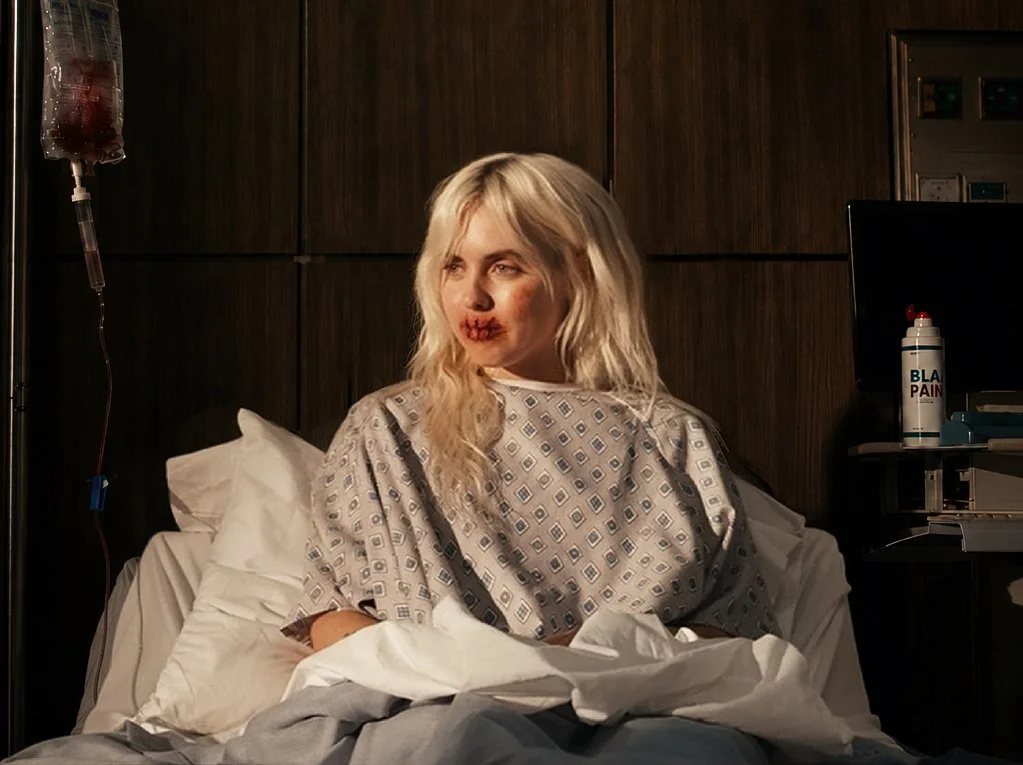
Having premiered at the 2026 Fantastic Fest, Justin Floyd's Jollyface is a social horror film that follows interracial couple Nick (Kofi Siriboe) and Blair (Emily Kimball). The movie starts off strong, reliving their memories through Nick’s lens and pulling the audience into their relationship. But Floyd’s debut feature film changes its tone when the strong-spirited Nick is shot and killed just after the opening act.
While the police dismiss the murder as a case of Black-on-Black crime, Blair steals security footage from her friend Charlotte (Alexis Louder), a Black cop, and discovers the killer is actually a white man in blackface—the Jollyface—who is actively being protected by the police. What follows is a race against time as Blair tries to expose the truth while being hunted in the safety of her own home.
The opening successfully makes the audience care about Blair and Nick before everything falls apart, using Nick's career as a cinematographer to frame their relationship through intimate, warm footage. The early diner scene where Blair is convinced a white old man is staring her down for being in an interracial relationship—only to realize he is blind—is one of the most effective moments. These scenes are heartwarming, funny, uncomfortable, and set up the film's theme and pacing efficiently. Floyd clearly knows how to create tension without relying on shock value to carry it.
The villain's design is also a brilliant showcase. Blackface as a horror concept is disturbing in a way that reminds us it can happen anywhere, and the image sticks. The reveal that the police deliberately dismissed the case is where Jollyface finds its sharpest edge—particularly the moment Blair watches the footage herself and realizes the cover-up wasn't negligence, it was a choice. The system didn't fail Nick. It worked exactly as intended.
At the same time, it loses some of its footing by packing too much into 77 minutes. Some loose plot points could easily add 20 more minutes to the film. Nick's death, which should carry the film's emotional weight, happens so quickly that Blair's grief reads more like restlessness. It makes it harder to be sure whether her fight for justice comes from love or from her ambition to prove to everyone it was a hate crime.
A Black female cop in the film who openly supports “Blue Lives Matter” sits opposite Blair without much comment. Floyd seems to want those contradictions to rub against each other. There is something deliberately uncomfortable about a Black woman defending the institution that buried Nick's case, while a white woman is the one tearing it apart. The film doesn't tell you what to do with that, it pointedly refuses to take a stance, and lets you sit with the discomfort instead. That restraint is one of its more deliberate choices.
The sound editing is one of the cleaner technical achievements. A ticking sound begins every time Blair gets close to a revelation, acting as a countdown in the audience’s minds, and builds a sense of tension at every opportunity as we wait for something to go wrong. Jollyface is scarce with jumpscares in a way most current horror films are not, meaning they land well when they do happen. It is a film with a clear point of view and the craft to support it most of the time. Although its ambitions are larger than it accomplishes, it reminds the audience that allyship doesn't follow the lines you expect. Solidarity can come from where you least anticipate it, and silence from where you most assume it won't—a white woman tearing apart the system, a Black cop choosing to protect it.
Jollyface is worth seeing for that discomfort alone. It is the kind of horror film that uses its scares to ask a question it refuses to answer: what does it actually mean to be on the right side?