
In Conversation: ‘Littermates’ Cast and Crew
By Karen Reyes
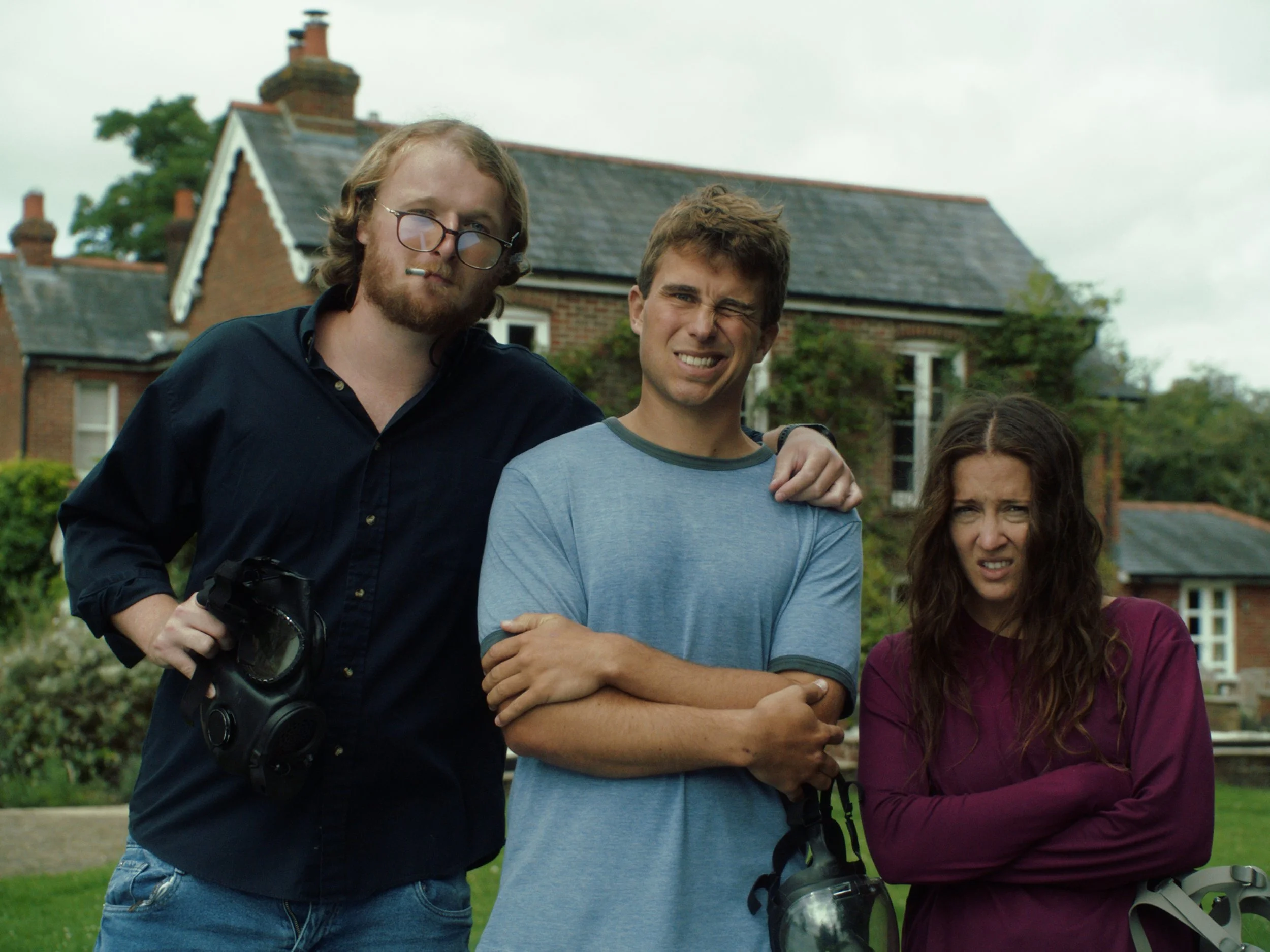
Growing up with siblings means your best friend and your greatest enemy are a package deal. Petty competition, trivial fights, and the occasionally heartwarming moments frame this universally known dynamic, but Littermates (2026) sets it against a dystopian backdrop and beautifully weaves in complex and intentionally vague found family threads. At Fantastic Fest 2026, co-Directors Scott Tinkham and Michael Woloson, and actors Joey Bader and Oliver Woolf, shared with us the process of creating Littermates, what it was like to work together, and the reasons behind focusing on siblinghood.
This interview has been edited for clarity and brevity.
Littermates obviously focuses on the sibling dynamic between Liam and Mel—even with the looming threat of the dystopian world around them, we zoom in for a very close look at their relationship which could easily have taken on a different dynamic. What is it about sibling relationships specifically that inspired you to make this movie?
SCOTT TINKHAM: I think it just naturally went there through the iteration process of the script. When we were writing this, we’d go directions and we didn’t really know where that would take us. And then we would have a discovery over here, and we would be like, “No, we don’t want to go in that direction so let’s go this direction.” And it just naturally ended up being a character piece about siblinghood because, honestly, Joey and Kaylee’s dynamic, as human beings, they have very sibling-esque dynamics in real life. So it was just playing to that and—this sounds really pretentious, but the film wanted itself to be a certain way at some point. I don’t even know, it was so natural how everything landed and the themes that were given to us based on all the constraints that we had.
MICHAEL WOLOSON: We all grew up with siblings, too. It’s just ingrained in all of us, this understanding of that. And I think it naturally comes through your work because of your upbringing.
Liam and Chester’s relationship completely subverted my expectations for this film. While I was expecting Chester to turn out to be this crazy, evil guy actively looking to harm people, he ended up being just a mildly strange parental figure to Liam and Mel in a really funny and sometimes offputting way because it seemed like he had experience. Joey, how did you approach having to act in those different phases of development throughout the film? And Oliver, how did you prepare to capture that eerie parental side of Chester?
JOEY BADER: It was something we talked about really early on. We used to all live together, so I was always doing characters, trying to make Scott laugh—one of them was a little kid. So it was kind of cool that he was like, “I’m writing this thing where you’re going to get to do that and then you’ll age a little as we go.” I guess in the beginning, I’m almost like a toddler in those first scenes. Eventually, I’m like an angsty teen by the end of it. So it was really nice and Michael did a great job with the stylists as well to age up my clothes as we were going. Each day I knew what we were filming and I was like, “Alright, this is the mindset I have to be in. I’m [at] this stage of life.” I remember my childhood a lot as well. I know sometimes people don’t have deep memories but I remember everything, so I remember what it felt like to be in sixth grade versus late high school—
TINKHAM: Really?
BADER: Yeah. And second grade, so it was really fun. It was cool, each day being something a little bit different instead of the same role throughout.
OLIVER WOOLF: I think for the parenting side of things—these three are my best friends. I’m just so protective of Joey all the time. He just needs a helping hand in the world sometimes, so that natural parental instinct just flowed through me. I just wanted to make sure he was okay in the big scary world.
TINKHAM AND BADER: [laughter]
The location for this film really makes you feel like you’re alone with the characters and it’s a beautiful backdrop for the story—why did you choose a remote, isolated setting for the story?
TINKHAM: It was a necessity because of a lack of budget, honestly. We made this very, very scrappy. It was very much a labor of love, so we had to write the script based around the location that we had access to. It opened our minds creatively, in a weird way, because we couldn’t shoot in a city. This movie couldn’t go places that other movies could go because we simply couldn’t, we didn’t have money for it. We couldn’t have 50 extras come in and do a crazy scene, so we had to think on a smaller scale which, in turn, freed us up to really home in on what we could do in the limited space that we had.
Along with your great performances, Kaylee McGregor’s performance really added another layer of depth and comedy to the family dynamic. What was the most enjoyable part of developing these characters together and what was the most challenging?
WOOLF: I think the fact that we’re all best friends—we all know each other’s idiosyncrasies and what we find crazy or strange or disturbing. So I think leaning into that and—I mean, Scott and Michael can talk more about what the process of creating the characters was—but I think knowing each other so intrinsically just made it so much fun to have to form these characters and their relationships out of friendship.
WOLOSON: We’ve all been friends for almost 10 years and the collaboration of making the film, in general, was so much fun. And I think the development of the characters is a very fundamental part of making films so it was just a natural, fun experience for all of us to do it together.
TINKHAM: It was like summer camp!
How did you all meet?
BADER: We met in film school, us three [Tinkham and Woloson], in LA and our other friend met Ollie and was like, “You gotta meet this guy,” and we met him a couple of years after we all met and it was love ever since.
TINKHAM: I remember first meeting Ollie. It was in Minnesota. I was picking him up for a shoot and it was a hockey movie and he winks at me. I was picking him up from the airport and he winks at me. I was like, “Who the hell is this guy?” Why would you wink at me? The first interaction you have with someone and they wink at you? Are you from the future or something?
WOOLF: My first interaction with Michael, properly, was when we were on this set in Minnesota and we had to pick up a food order and we went to Wendy’s. We took the orders on a phone and it was genuinely like 10 Baconators, that was it, 10 Baconators from Wendy’s. And Michael pulls into the drive-thru and he just goes, “Hey, can we have a Baconator? And then, uh, another Baconator? And then another Baconator? And then we’re just going to have another Baconator.” I thought, this guy’s going to be very important in my life.
The ending of the film feels very final in an ironic and morbidly funny way but also open-ended for Liam and Mel’s relationship. Why do you think it was important for the story to end that way for them?
TINKHAM: I’ve been thinking about the ending a lot lately. It’s a moment of decision we all have—well, we haven’t had this yet—when your parents are gone, when suddenly you lose a loved one and they’ve been caring for you all your life, what does that do to siblinghood? We’re still here, we’re going to figure that out moving forward, but it really is a crazy moment of decision. Do you get closer? Or do you drift apart even more? That’s the dramatic question at the end there.
Was there anything else about the film that you wanted to share that I might have missed?
TINKHAM: Something nobody talks about in this movie is the recurring fly in this film. It’s significant because it’s a “mistake.” Other movies would be like, “Oh, we can cut around the fly.” Ollie at the dinner scene reacting to the fly going by and then locking back into the scene is what we were seeking to do, finding these moments of genuineness. We did not set out to make a movie, we set out to make a very niche and very open-ended feeling. Like it can just exist, in a way. That recurring fly happens three times perfectly in the movie. Once, in the beginning, it flies by when [Liam’s] hiding from Chester—
BADER: I think it was five times.
TINKHAM: Huh, there were a lot of flies, I guess. But it happened at the perfect moments, and again at the end. In the very last shot, a fly just flies into the scene and it hangs on the polaroid.
BADER: I’ve been on the biggest film sets as crew and then the smallest run-and-gun stuff and something that’s kind of lacking from the giant film sets is, everyone is so locked in to their job and the hierarchy is so locked in, but there is something special about a full collaborative effort. We had such a great crew, there were like, 10 of us, basically. And there were times when I was gaffing for Michael and then I would be in the next shot and the crew were open to suggesting something for the scene. A lot of them were British, too, so it’s their home country, they would have an idea for something or certain vocabulary or something with the landscape.
We listened to everyone and that’s a testament to Michael and Scott—especially Scott being the writer, he’s totally open to “a good idea can come from anywhere” so I would just say, when you’re making a film, it is more fun if you’re all collaborative. Yes, there are times to stay in your lane and respect the hierarchy and lock in and get stuff done but a good idea can come from anywhere. To me, it makes it more fun. I don’t want to be isolated, I want to be all run-and-gun together, so shout out our crew because they were awesome.