
Tangles: A Poetic Tale of Hope and Grief
by Romane Tissandier
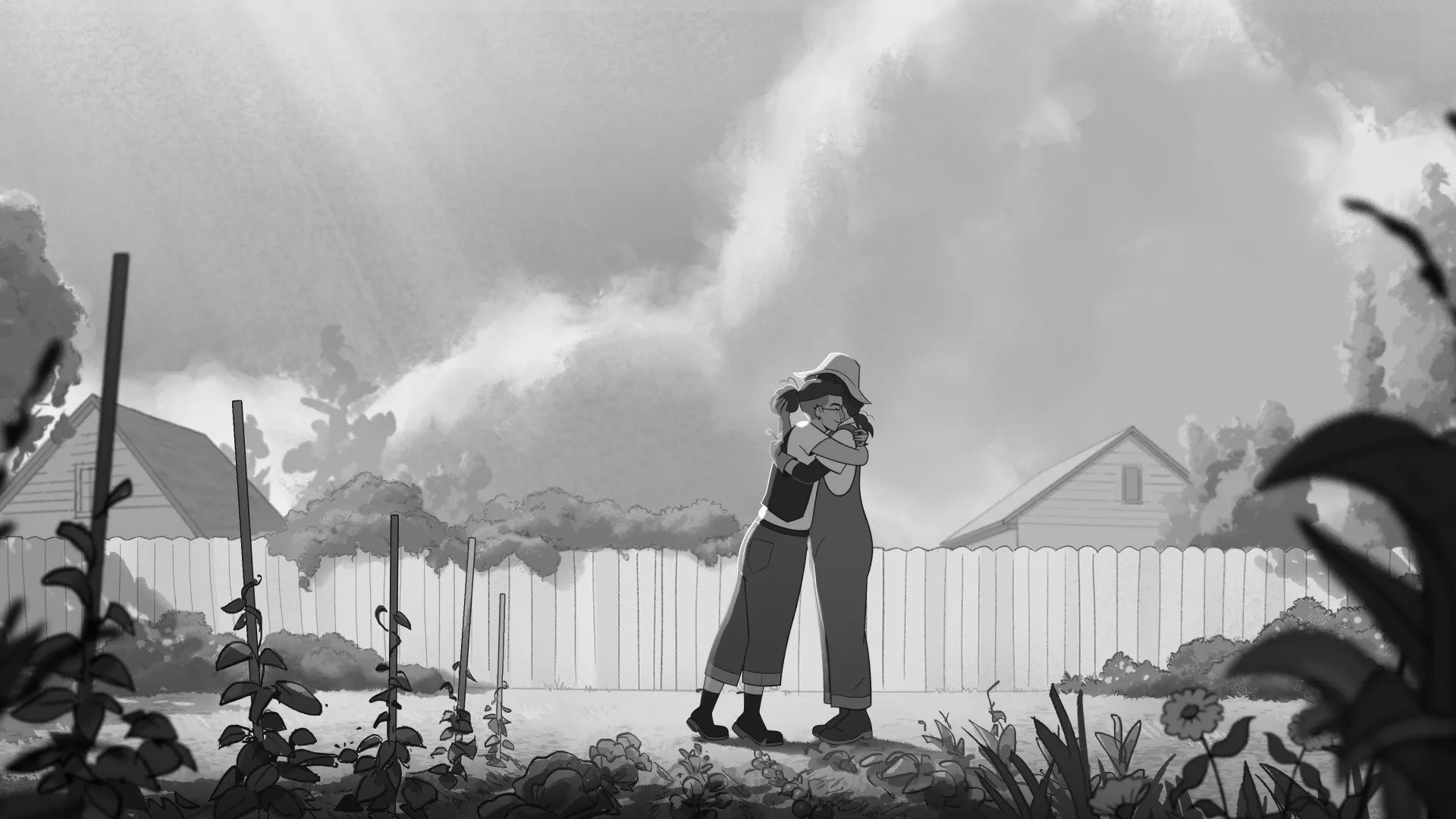
Sarah, a strong-headed artist and activist in 1990s San Francisco, distances herself from her newly independent life when her mother Midge is diagnosed with Alzheimer’s disease. As the young woman’s visits to her hometown become more frequent, time runs out faster than expected and she must learn how to make the most out of each precious moment. Adapted from Sarah Leavitt’s autobiographical graphic novel, Tangles offers Leah Nelson a complex and touching story for her first film, which was featured in the Official Selection of the 2026 Annecy Festival. Exploring the fragile structure of a family, the film portrays Sarah’s journey through this unexpected event which brutally changes the life she built for herself.
Leavitt’s story is translated to the big screen in a sharp black-and-white 2D animation style, blending rich and creative representations of Sarah’s interior chaos with more minimalist scenes. Sarah’s lesbian identity is also well incorporated into the story without being its main topic. Her life in San Francisco is inspired by the city’s 1990s radical lesbian scene, contrasting with the simple environment of her hometown. And the love story developed throughout the film with Donimo’s character, who tries to support Sarah as best as she can, brings a welcomed touch of tenderness between some harrowing sequences. It is a wholesome example of queer representation which is not used as a source of conflict between the characters and exists within the narrative without being questioned.
As Midge loses autonomy and strength, her family has to build a new structure to support her, resulting in inevitable tensions between the family members. The witty dialogues both reflect the unintentional humour of familial conversations and the omnipresent anxiety dwelling in all of them, allowing the audience to deeply connect with the family’s struggles and understand why their reactions are so different.
Tangles makes the most out of a medium with endless possibilities to visually represent the interiority of its characters: As Sarah looks for her mother in the middle of a crowded street celebrating the Day of the Dead in Mexico, anonymous faces become scary skulls, and when she tries to draw the covers for her magazine, only tortured illustrations appear on the paper. Other beautiful, abstract sequences paint the drowning sensation provoked by Alzheimer’s from Midge’s perspective, bringing viewers closer to her and the other characters’ perceptions and feelings.
Capturing the heart-wrenching weight of every interaction between Sarah and her mother, the film lets the emotion take over through subtle changes in everyday situations, without forcing it upon its audience. Tangles is an impressive combination of incisive, cleverly placed humour, and a moving depiction of the grief that comes with watching a loved one slowly leave our life without any possibility of coming back.