
Good Luck, Have Fun, Don’t Die: The Future Is Bright, Right?
by Romane Tissandier
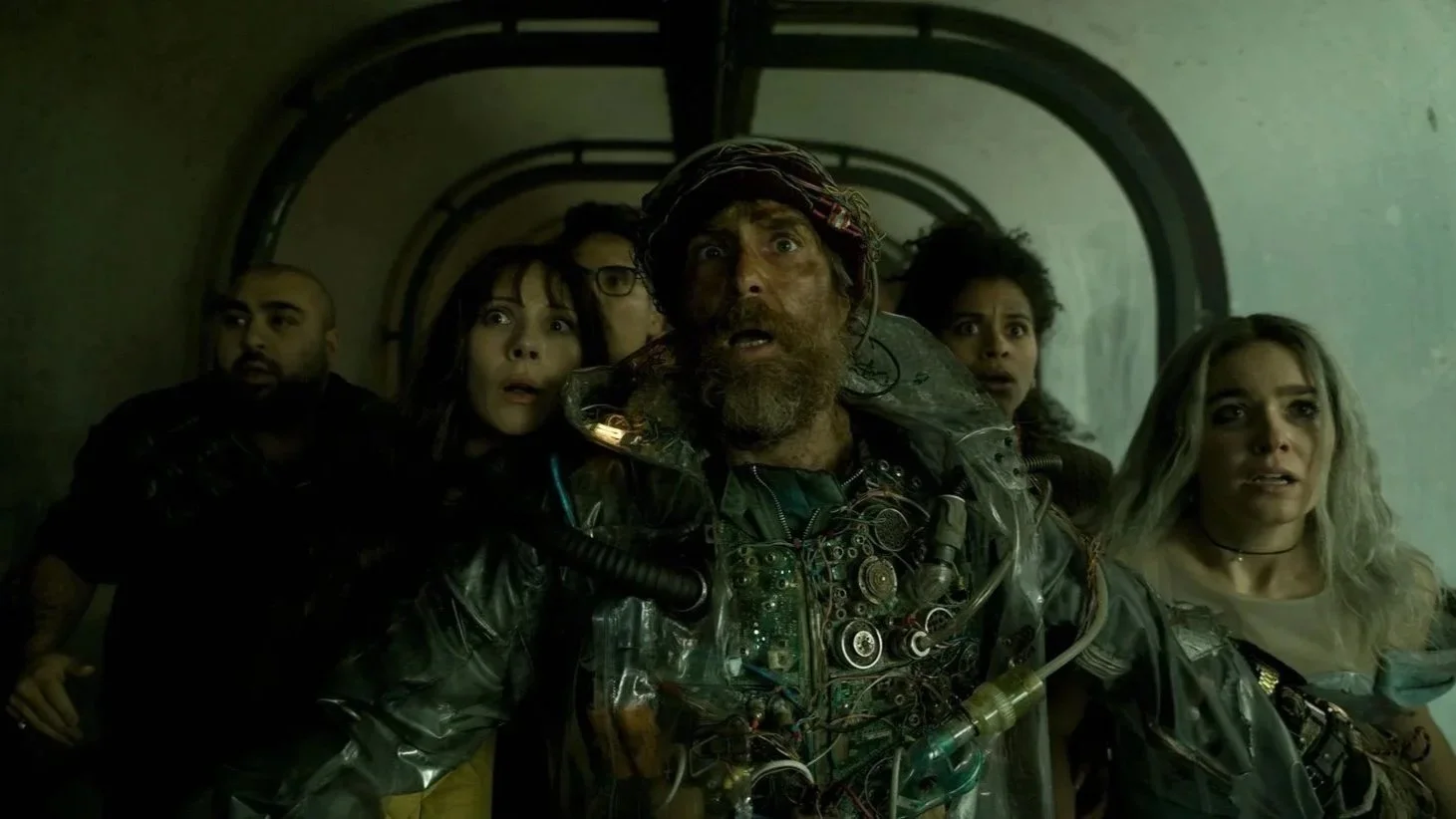
On a random evening in a Los Angeles diner, a “man from the future” (Sam Rockwell) assembles an unlikely team of strangers to rid the world of a rogue artificial intelligence. What follows is a frantic race to save humanity from its own creation. Gore Verbinski’s latest science fiction comedy resorts to an eccentric type of satire to expose our collective responsibility regarding the rise of generative AI.
Good Luck, Have Fun, Don’t Die relies on a typical sci-fi movie structure with its team of questionable yet relatable protagonists, a dreadful invisible villain, a few mysteries to solve along the way, and a grand final battle filled with action and heroic gestures. But this clear narrative allows some surprising digressions: Long flashbacks dive into the characters’ backgrounds, whose lives have all been affected by the growing power of AI. Zombie-like teenagers are glued to their phones, a company creates clones of children killed in school shootings, and a virtual reality convinces its users to leave the real world for good. The characters’ ambitious quest cleverly leads the audience to reflect on the normalization of violence in our daily lives, our tendency to react only when it is too late, and our relationship to grief in a society that only wants us to move on.
Sam Rockwell’s fiery interpretation of his nameless character captures our attention from the start with his brilliant opening monologue. He shows the underlying mystery and sadness surrounding this man while making him the center of attention, entertaining the audience with his dramatic outbursts and cynical remarks.
Another standout performance is Haley Lu Richardson’s seemingly effortless charisma as Ingrid, a disillusioned young woman allergic to Wi-Fi who no longer believes in a livable future for herself. She subtly juggles the comedic side of her character—constantly bored and in a bad mood—with her hopelessness towards the world she lives in, contrasting admirably with the overall urgency of the story.
Through costumes and props directly influenced by 1980s sci-fi movies, Good Luck, Have Fun, Don’t Die mixes a contemporary technological issue with an inventive visual identity, from the man from the future’s excessively complicated costume to what can be described as anti-phone weapons to the delirious representations of AI-generated prompts. Following a sometimes overwhelming rhythm, the film also makes the most out of each location. Whether it is the diner, an empty parking garage, or a house they break into, every sequence is finely staged, relying on the specific objects and possibilities offered by those settings and allowing for creative action scenes.
The film resonates enough with our own reality that we can take it as a direct warning to not let generative AI infiltrate our lives and turn us into completely dependent beings. Yet it is the absurd and satirical humor of Good Luck, Have Fun, Don’t Die that leads us to question our behaviour, because as much as we want to laugh at what we see on the screen, we quickly understand it is not as far from reality as we would like.